HOW CAN WE HELP YOU?

Mobile CallClick to Call
Choice One Insurance, Inc

8800 SE Sunnyside Rd, Ste 225-S
Clackamas, OR 97015

Map IconGet Directions
  • Icon Quote REQUEST A PROPOSAL
  • Arrow Icon
    Icon Auto Motor Carrier
    Defender
  • Arrow Icon
    Icon Home Owner-Operator
    Protector
  • Arrow Icon
    Icon Commercial Contractor
    Defender
  • Arrow Icon
    Icon Life Personal
    Lines
 
  • Choice One Insurance, Inc Blog
  • Contact Choice One Insurance, Inc
  • Make A Payment

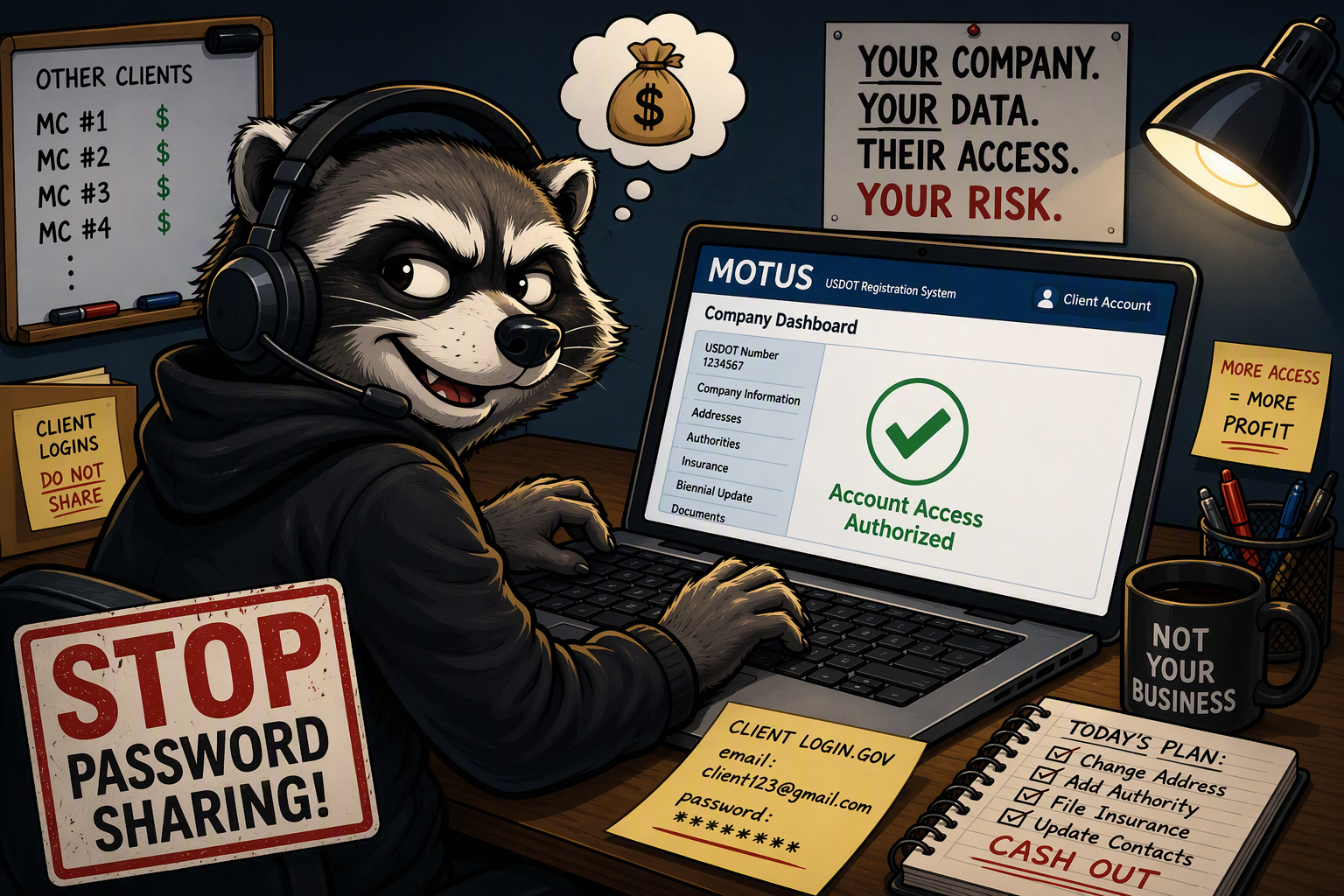
Would You Hand a Stranger the Keys to Your Truck? Then Why Share Your Login.gov Password?

By Andrey Shulik, CIC/CRM

Why FMCSA Is Tightening Security — and Why That’s a Good Thing

For years, small trucking companies have relied on dispatchers, permit agents, compliance consultants, licensing services, and other third-party providers to help keep their businesses running. There is nothing wrong with seeking professional assistance. In many cases, these service providers play an important role in helping motor carriers navigate regulatory requirements and administrative tasks.

Many of America’s small trucking businesses are owned and operated by hardworking immigrants. These business owners often face significant challenges, including limited time, limited administrative resources, language barriers, and the overwhelming demands of operating a transportation company. Between servicing customers, managing drivers, maintaining equipment, and complying with regulations, it is understandable why many carriers seek outside help.

Unfortunately, this reality has also created a dangerous habit throughout parts of the trucking industry: sharing usernames, passwords, and account credentials.

Far too often, trucking company owners provide access to critical systems by simply handing over their login information. In some cases, they share Login.gov credentials, FMCSA accounts, email passwords, banking access, insurance portals, and other sensitive business systems with individuals they barely know.

Even more concerning, many of these arrangements are established without:

  • Written contracts
  • Confidentiality agreements
  • Privacy policies
  • Cybersecurity protections
  • Professional liability insurance
  • Documented operating procedures
  • Proper verification of the service provider’s legitimacy
  • Any meaningful control over who actually has access to company data

Many business owners assume that because someone is helping them with permits, dispatching, safety, compliance, or insurance, that person can be trusted with complete access to their business. Unfortunately, that assumption can create significant risk.

Identity Theft in Transportation Has Become a Serious Problem

The transportation industry has experienced increasing concerns surrounding identity theft, fraudulent carrier operations, unauthorized account access, and so-called “chameleon carriers” that attempt to hide poor safety records or enforcement history behind new company identities. As a result, industry participants have significantly increased their focus on verification and accountability.

Freight brokers and shippers frequently use sophisticated onboarding platforms to verify who actually owns and controls a trucking company before awarding freight. Insurance companies are paying closer attention to ownership structures, operational control, and the identities of individuals who represent transportation businesses. Government agencies are also implementing stronger controls designed to reduce fraud and improve accountability.

MOTUS should be viewed in this broader context.

MOTUS Is About More Than Registration

Many carriers see MOTUS as simply a replacement for older FMCSA systems.That view misses a much larger point.

MOTUS was designed to help ensure that individuals accessing carrier information are properly identified and authenticated. The system relies on Login.gov identity verification and is built around the principle that every user should have their own verified identity. This represents a significant shift from longstanding industry habits.

Historically, many companies operated under a simple approach:

“Just give the dispatcher my password.”

Or:

“My permit company handles everything, so they have all my logins.”

Or:

“My cousin set up the account and knows the password.”

Those practices may have been common, but they were never good security. MOTUS is designed to eliminate the need for credential sharing by allowing authorized users to be given appropriate access without requiring the owner to surrender control of the account.

Sharing Login.gov Credentials Is Not Okay

A Login.gov account is intended to represent a specific individual’s verified identity.

When a trucking company owner shares Login.gov credentials with another person, several problems immediately arise:

Nobody can determine who actually performed actions within the system. Multiple individuals may be operating under a single identity. Sensitive company information becomes vulnerable to misuse. Unauthorized changes become difficult to investigate. Former service providers may continue to possess access long after the business relationship ends.

The risk becomes even greater when credentials are shared with individuals or businesses that operate without contracts, licensing, professional insurance, cybersecurity controls, or formal accountability.

Unfortunately, some trucking companies routinely grant complete access to people they have never met in person and know only through social media, messaging apps, or informal referrals.

No business owner would casually hand over the keys to every truck in the fleet to a stranger. Yet many routinely hand over complete access to their digital business.

The Proper Way to Use MOTUS

The model that FMCSA is promoting is actually quite straightforward.

Each individual should maintain their own Login.gov account. Each user should complete their own identity verification.

The business owner should control the company’s MOTUS account in administrator capacity. If assistance is needed, the company administrator can grant appropriate access rights to authorized users. If a relationship ends, those permissions can be modified or removed.

This creates accountability while allowing legitimate service providers to continue helping carriers manage regulatory responsibilities.

Most importantly, it creates a clear record of who is accessing the system and what actions they perform.

A Needed Cultural Change

Technology, cybersecurity, and fraud prevention are no longer issues reserved for large corporations. Small trucking companies face the same threats as larger businesses, often with fewer resources available to protect themselves.

The industry must move beyond a culture where passwords are written on scraps of paper, shared through text messages, sent through social media platforms, or provided to anyone offering administrative assistance.

Professional service providers can and should continue supporting motor carriers. However, that support must be provided through secure access controls, proper authorization procedures, and individual user identities.

MOTUS is not simply another government website. It is part of a larger effort to improve security, reduce fraud, combat identity theft, and ensure accountability within the transportation industry. Carriers who embrace these changes will be better positioned to protect their businesses, their operating authority, and their future.

Because protecting access to your company is every bit as important as protecting the keys to your truck.
Nuclear Verdicts and Legal System Abuse impact on Consumer Prices

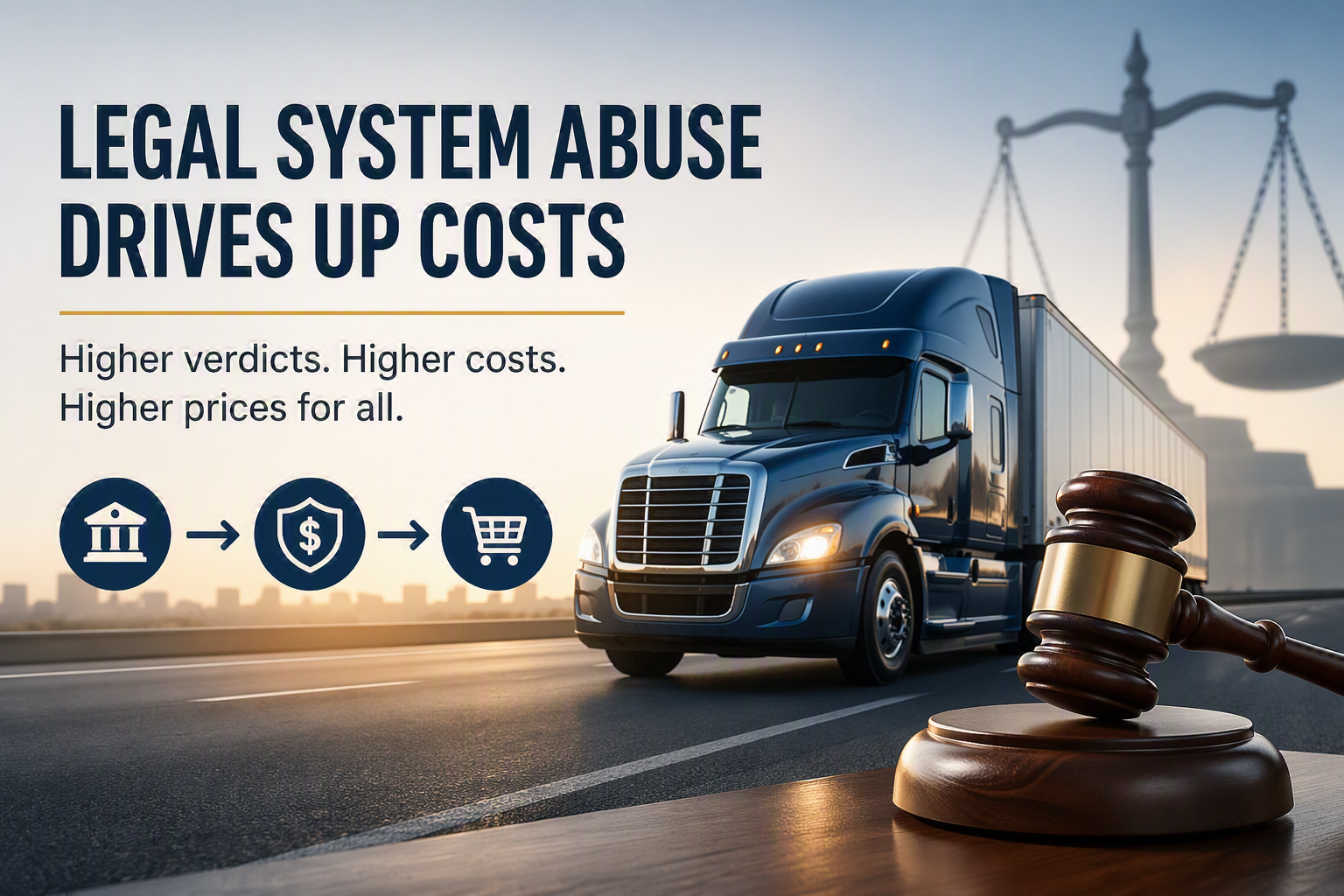
How Nuclear Verdicts and Legal System Abuse Are Reshaping Transportation and Raising Consumer Prices

By Andrey Shulik, CIC/CRM

Most Americans never think about the legal system when they buy groceries, order products online, or purchase building materials for a home project. Yet a growing body of research suggests that significant changes in the civil litigation environment are increasing costs throughout the economy, particularly within the transportation industry that serves as the backbone of America’s supply chain.

At the center of this discussion are two terms that have become increasingly common in insurance, transportation, and legal circles: nuclear verdicts and social inflation. While these concepts may sound like industry jargon, their effects can eventually reach small businesses and consumers across the country.

Understanding Nuclear Verdicts

A nuclear verdict generally refers to a jury award that exceeds $10 million. While severe injuries and losses can justify substantial compensation, many insurers, trucking companies, and industry researchers argue that the frequency and size of these awards have increased dramatically in recent years.

The transportation industry has become particularly vulnerable to large verdicts because commercial trucks are involved in high-severity accidents, operate in public view, and typically carry significant insurance limits. Plaintiff attorneys often view trucking companies as attractive litigation targets because of the perception that transportation businesses have substantial financial resources or insurance coverage available to pay claims.

Research conducted by the American Transportation Research Institute (ATRI) has documented a significant increase in both the number and size of large verdicts against trucking companies. According to ATRI, verdict awards in trucking litigation have grown at a rate that far exceeds both general inflation and healthcare cost inflation.

The Concept of Social Inflation

Insurance economists often use the term social inflation to describe increases in claim costs that cannot be explained solely by traditional economic inflation.

The Insurance Information Institute (Triple-I) and the Casualty Actuarial Society (CAS) have published research indicating that social inflation has contributed billions of dollars in additional commercial auto liability losses over the past decade. Their research suggests that liability claim costs have increased beyond what would normally be expected from standard economic factors.

Several factors are commonly associated with social inflation:

  • Larger jury awards
  • Longer and more complex litigation
  • Growing acceptance of large damage awards
  • Third-party litigation funding
  • Expanded theories of liability
  • Increased attorney advertising
  • Changes in public attitudes toward corporations and insurers

Researchers note that social inflation is difficult to measure precisely because it involves a combination of legal, societal, and economic influences. Nevertheless, actuarial studies have found evidence that claim costs in commercial auto liability have risen substantially faster than underlying inflation trends.

Why Trucking Has Become a Primary Target

Few industries feel the impact of litigation trends more directly than trucking.

Every trucking company must maintain liability insurance. When claim severity increases, insurers must adjust premiums to reflect anticipated future losses. The result is often higher insurance costs for motor carriers, regardless of whether an individual company has experienced a serious claim.

Transportation companies today face multiple financial pressures:

  • Rising insurance premiums
  • Larger deductibles and self-insured retentions
  • Increased legal defense costs
  • Reduced availability of insurance capacity
  • Greater pressure to adopt extensive risk management programs

Sentry Insurance, which insures transportation businesses throughout the United States, has publicly stated that legal system abuse contributes to nuclear verdicts and escalating litigation expenses that ultimately increase insurance costs within the trucking industry. The company has also identified legal reform initiatives as one of its major public policy priorities.

Legal System Abuse: What Reform Advocates Mean

Supporters of legal reform often emphasize that their goal is not to prevent legitimately injured individuals from receiving compensation. Instead, they argue that certain legal practices can distort outcomes and create costs that extend beyond the parties directly involved in a lawsuit.

Among the practices frequently cited are:

Third-Party Litigation Funding

Third-party litigation funding occurs when outside investors provide financing for lawsuits in exchange for a share of any future settlement or verdict. Critics argue that this arrangement can encourage prolonged litigation and higher settlement demands. Supporters maintain that it helps plaintiffs pursue legitimate claims that they otherwise could not afford.

Phantom Damages

Some reform advocates argue that juries should hear evidence regarding the amount actually paid for medical treatment rather than only the amount initially billed. They contend that substantial differences between billed and paid amounts can lead to inflated damage calculations.

Venue Shopping

Venue shopping refers to filing cases in jurisdictions perceived to be more favorable to plaintiffs. Critics argue that this practice can create inconsistent legal outcomes and contribute to larger verdict awards.

Jury Anchoring

Jury anchoring occurs when extremely high dollar figures are suggested during litigation, potentially influencing how jurors evaluate damages. Some states have considered reforms intended to address these tactics.

The Hidden Impact on Small Businesses

For many small business owners, nuclear verdicts may seem like a problem affecting only trucking companies, insurance carriers, and attorneys. In reality, the economic consequences can spread far beyond the courtroom.

Transportation costs influence nearly every product sold in America. Food products, clothing, electronics, construction materials, medical supplies, and consumer goods all rely on freight transportation at various stages of production and distribution.

When liability costs increase, trucking companies often face higher insurance premiums. Those additional expenses become part of operating costs and may ultimately be reflected in freight rates. Manufacturers, distributors, wholesalers, and retailers then absorb or pass along those increased costs.

The result is a ripple effect that touches many parts of the economy.

For a small retailer, transportation cost increases may reduce profit margins. For a construction contractor, they may increase the cost of materials. For consumers, they may contribute to higher prices for everyday goods.

The Broader Economic Debate

The U.S. Chamber of Commerce Institute for Legal Reform has estimated that costs associated with the U.S. tort system represent hundreds of billions of dollars annually and amount to thousands of dollars per household. Research published by the organization suggests that litigation-related costs have grown faster than inflation and GDP over recent years.

At the same time, many legal professionals and consumer advocates argue that substantial verdicts can reflect the true costs of catastrophic injuries and serve an important role in holding negligent parties accountable. They caution against reforms that could limit access to justice or reduce compensation for seriously injured individuals.

This debate ultimately centers on a difficult policy question:

How can society ensure fair compensation for victims while maintaining a legal environment that does not create excessive costs for businesses, consumers, and the broader economy?

There is no simple answer, which explains why legislatures across the country continue to grapple with these issues.

Legislative Responses

Several states have recently enacted or considered legal reforms addressing topics such as comparative negligence, disclosure of litigation funding, admissibility of medical billing evidence, venue rules, statutes of limitation, and jury procedures.

Organizations representing trucking companies, insurers, manufacturers, and other business groups have been actively involved in these discussions, arguing that greater transparency and balance are needed within the civil justice system.

At the same time, plaintiff attorneys and consumer advocates continue to oppose many of these proposals, arguing that existing legal remedies remain essential for protecting injured parties and ensuring accountability.

Conclusion

Nuclear verdicts and social inflation may appear to be distant issues confined to courtrooms and insurance companies, but their effects often extend far beyond legal proceedings.

For trucking companies, the consequences can include rising insurance costs and increased operational expenses. For manufacturers and retailers, transportation costs can become more expensive. For consumers, those costs may ultimately appear in the prices paid for everyday goods and services.

As litigation trends continue to evolve, the debate over legal system abuse, tort reform, and nuclear verdicts is likely to remain one of the most significant public policy issues affecting the transportation industry and the broader economy.


References

  1. American Transportation Research Institute (ATRI), Understanding the Impact of Nuclear Verdicts on the Trucking Industry, 2020.
  2. Insurance Information Institute (Triple-I) and Casualty Actuarial Society (CAS), Social Inflation and Loss Development – An Update, 2023.
  3. Insurance Information Institute (Triple-I), Social Inflation: What It Is and Why It Matters.
  4. U.S. Chamber of Commerce Institute for Legal Reform, Tort Costs in America, Third Edition, 2024.
  5. U.S. Chamber of Commerce, The Hidden Costs of Lawsuits Continue to Grow.
  6. U.S. Chamber of Commerce, Lawsuit Costs Are Escalating, and U.S. Households Are Paying the Price.
  7. Sentry Insurance Government & Regulatory Affairs, 2025 Legal System Abuse Reform Report.
  8. Sentry Insurance transportation industry materials and customer communications regarding legal system abuse reform and transportation litigation trends.

Why Your Business Should Consider Cargo Insurance

Whether you’re shipping products across town or around the world, your cargo faces numerous risks during transit. Many business owners assume their standard business insurance or the carrier’s coverage will protect their goods, but this often leaves significant gaps in protection. At Choice One Insurance, Inc., serving Portland OR, we help businesses understand why cargo insurance is essential for protecting their valuable shipments.

Understanding Coverage Gaps

Shipping companies typically offer minimal liability coverage that falls far short of your cargo’s actual value. Their coverage often excludes common causes of loss, like weather damage, theft, or handling errors. If your shipment gets damaged or lost, you could face substantial financial losses without proper cargo insurance. This protection becomes even more critical when shipping high-value items or products essential to your business operations.

Beyond Basic Coverage

Cargo insurance provides comprehensive protection that follows your goods from origin to destination. This coverage protects against risks like fires, theft, collisions, natural disasters, and even "mysterious disappearances" (unexplained losses without evidence of theft or accident). Unlike carrier liability, cargo insurance typically covers the full replacement value of your goods, helping you recover quickly from losses and maintain customer relationships.

Peace of Mind for Growing Businesses

As your business expands and shipping volume increases, the potential for losses grows proportionally. Cargo insurance allows you to take on larger orders and explore new markets with confidence. The relatively small premium provides significant protection that can prevent a single shipping disaster from devastating your business finances.

Secure Your Shipments

Don’t let inadequate coverage put your business at risk during transit. Cargo insurance provides the comprehensive protection your valuable shipments deserve. Contact Choice One Insurance, Inc., serving Portland, OR, to discuss customized cargo insurance solutions that fit your business needs and budget.

Does Small Truck Insurance or Delivery Insurance Cover Cargo?

Every delivery driver knows how important it is to ensure the cargo in the back of the truck is OK. Small truck insurance and delivery insurance can cover a few things, but how does it work when it comes to cargo? 

Standard Auto Policies

Standard commercial policies usually cover the vehicle itself. They may cover other people’s damages if you are found at fault for the accident. Most small truck insurance/delivery insurance policies are just standard commercial policies, so they may not cover cargo. Those that do will likely have a lower coverage limit. Ask an agent at Choice One Insurance Inc. if your insurance covers cargo. 

Cargo Insurance

If your current policy doesn’t cover cargo, you can get cargo insurance. This is an add-on for commercial auto policies. It will cover lost or damaged goods, and often covers items such as theft. Although policies do have a limit, it’s usually higher than the limit for cargo on standard auto policies. 

High-Value Items

Many policies specifically exclude high-value items, such as jewelry and electronics. These items are more likely to be stolen and are more expensive to replace. It’s common for companies to require additional coverage because you’re more likely to file a claim if you’re hauling high-risk items. 

At Choice One Insurance Inc., we understand the importance of ensuring that your cargo is properly covered. Customers can file lawsuits, putting your assets at risk. We’ll review your policy and discuss what cargo you’re carrying to ensure you have proper coverage. We can also discuss coverage for high-value items. Contact us to learn more. We’re currently serving the Portland, OR, area. 

What Type Of Insurance Does A Construction Company Need?

There are several types of commercial insurance available, and construction companies in Portland, OR, should consider specific policies to protect their business. While some types of insurance are mandatory, others can provide additional benefits.

Workers’ Compensation

By law, businesses with at least one employee are required to obtain workers’ compensation coverage in case someone gets hurt on the job. This is especially important for construction companies, as the repetitive motions and nature of the work typically lead to an increased risk of injury.

Specialty Contractors

Many companies, such as Choice One Insurance Inc., offer specialty contractors’ insurance. This type of policy is tailored to meet the unique needs of the construction industry. It often covers damage to tools, extends beyond general liability, and includes coverage for specialized machinery. An agent can provide more details about this type of coverage.

Auto Coverage

Every business, including construction companies, must have state minimum insurance for any vehicles driven on the road. Equipment driven on the road, such as backhoes, must also have minimum liability insurance in case of an accident. If you rent equipment, the rental company should already have a policy in place. However, it’s important to confirm coverage before operating the equipment.

Property Coverage

If your business has an office or specific workspace, property coverage will protect that area. This may not be included under specialty policies, so it’s important to ask an agent when obtaining all the coverage you need.

Agents at Choice One Insurance Inc. have experience working with contractors from various industries. We can help you learn more about the coverage you need before you start working. Contact us today. We’re currently serving the Portland area.

How to Tailor Specialty Contractors’ Insurance to Your Advantage

Occasionally, accidents will happen in the workplace. However, no specialty contractor wants to find out their insurance policy fails to cover the damage and injuries sustained in a work-related accident. The staff at Choice One Insurance Inc. in Portland, OR, can help create a specialty contractors’ insurance policy that meets your business needs.

What is Specialty Contractors Insurance?

Specialty contractors’ insurance offers a wide range of coverage options for commercial businesses under this umbrella. You will design a policy that fully protects your specialized trade without coverage gaps. Some common specialized trades include plumbing, HVAC, and residential or commercial electrical work. The coverage is tailored for specific risks associated with each specialized trade.

Understanding Your Business Risks

It is hard to fathom the number of projects a specialty contractor oversees each month. Often, the insurance coverage required differs from a standard commercial business insurance policy. You must identify the risks associated with each project before adjusting the coverage on your policy for specialty contractors. Keeping track of the coverage will ensure the specialty contractors’ insurance policy aligns with your business needs.

Add Professional Liability to Your Policy

Professional liability coverage protects against claims of operational errors, unexplained omissions, and professional negligence in the services provided. This addition to your insurance policy will protect your business from a lawsuit filed by a client. The suit will claim that your errors have caused immediate financial stress for them because they failed to complete the project on time. Professional liability covers all legal action, potential settlements, or past judgments.

If you don’t have specialty contractors’ insurance, it’s not too late to speak with Choice One Insurance Inc. in Portland, OR. Our staff can create coverage that protects your business interests. Please call and schedule a meeting today.

What is Covered by Cargo Insurance?

Coordinating transportation plans for shipments can be unpredictable. You want to choose a route least affected by extreme weather conditions, as failing to do so could result in missing a scheduled delivery deadline. The Choice One Insurance Inc. team in Portland, OR, can provide recommendations on the type of cargo insurance coverage that effectively benefits your business.

Defining Cargo Insurance’s Loading and Unloading Coverage

Loading and unloading coverage is a standard feature of most cargo insurance policies. Typically, it covers all damage or loss during the transfer from the transport vehicle to the loading dock. A forklift protects Your product from unexpected damage, such as dropping or crushing the goods. However, you are not covered if the damage was ruled to be caused by inherent product defects or improper packaging by your staff.

Cargo Insurance Coverage of Transportation Mishaps

Transportation mishaps with a company’s products happen all the time. Cargo insurance covers all damage or loss of your product caused by a natural disaster or on-road accident while en route to its final destination. Another policy option is protection from spoilage or contamination caused by sudden temperature changes in the truck’s storage refrigeration unit. This type of coverage is essential for businesses transporting fresh or frozen food nationwide. Having effective cargo insurance coverage creates a safety net for your business. It allows you to operate without delay. The coverage minimizes the financial impact of loss or product damage when a transportation mishap occurs.

If you plan to expand your business and sell your product nationwide, contact Choice One Insurance Inc. in Portland, OR. Our staff has the knowledge and experience to create a cargo insurance policy that protects your investment while in transit. Call and schedule an appointment today.

Specialty Contractors Insurance – Protection for Your Workers, Materials, and Equipment

Specialty contractors insurance provides coverage for a variety of trade services. Learn how this type of insurance can protect your workers, materials, and equipment used to perform job duties.

Specialty Insurance

Specialty insurance is a broad term that provides protection for many trades. A specialized contractor may rely on this type of coverage to protect them during each project they are hired for.

Specialty contractor’s insurance will protect a business of any size. Owners of small and large companies can customize an insurance plan that provides the exact amount of coverage needed.

Liability Coverage

Liability coverage is one type of specialty insurance that protects a contractor’s best interests. It protects against injuries and damage that may occur on a worksite.

The type of work you do should be considered. If you and your workers are exposed to dangerous conditions, acquiring a high amount of liability protection may be in your best interest.

Possession Coverage

Specialty insurance designed to cover possessions will prevent you from paying out-of-pocket costs for damaged equipment, tools, and materials. All the items used for contracting duties can be added to your specialty insurance policy.

  • Ladders
  • Toolboxes
  • Hand and power tools
  • Electrical equipment
  • Lumber
  • Insulation

This list highlights some of the items you can add to your specialty insurance policy. If items are stolen or damaged while a job is underway, your insurance coverage will pay to replace or repair them.

Contact a Representative of Choice One Insurance Inc.

Meet with one of our agents who serves Portland, OR. The agent will inquire about your contracting duties. Then, they will recommend specialty insurance products to you.

Keep Your Construction Crew Protected: Insurance Guidelines

Commercial insurance coverage will protect your construction crew members from accidents, theft, and other damages that occur on a worksite. Learn about some types of commercial insurance. Afterward, contact one of our Choice One Insurance Inc. agents who serve Portland, OR.

Workers Compensation

Workers compensation provides cash benefits and medical care to employees who are injured on the job. This coverage takes effect after an insurance claim is filed and approved.

The financial relief and medical coverage a workers’ compensation policy offers will allow employees to maintain their household bills and receive adequate care during their recovery.

Personal Property

Personal property coverage protects against theft and vandalism. If an employee is responsible for furnishing their own tools and equipment during normal business hours, it is in a business owner’s best interest to provide adequate insurance coverage.

The employer should take note of all the possessions that each employee will be using. If any of the items are stolen or damaged while a construction crew is working, the employer should report the matter to their local police department. Then, they should file an insurance claim.

Safety Measures

A construction site should be accessible to any worker who will be doing services. Adequate lighting and surveillance equipment can be used to increase safety on a construction site.

Areas that are off-limits to a construction crew should be clearly marked. Each construction site where work will be conducted should be inspected individually. Then, safety measures should be used to prevent mishaps on the worksite.

Consult With Us

Contact our Portland, OR team at Choice One Insurance Inc. We will prepare an insurance policy that will provide your construction crew with adequate protection.

When Does it Make Sense to Buy Cargo Insurance?

Have you ever shipped something across the country and wanted to ensure the protection of that valuable? If so, cargo insurance is the product you need to be considering. Working with our team at Choice One Insurance Inc. we are here to help you understand the cargo insurance product. We can assist folks in Portland, OR or anywhere else in the United States. Whether it is education for consideration of cargo insurance or to buy the product outright, you need to know what it is, the coverage you need, and more.

Understanding Cargo Insurance

Cargo insurance provides a lot of value in the event that you are doing shipment of a variety of different products. Think about cargo insurance as protection for shipments. When you are shipping something valuable, cargo insurance is going to protect you from loss, damage, or theft while that item is in transit.

When shipping, cargo insurance starts with coming up with the value of those items. What is it that you are shipping and what is the value of it? Can it easily be replaced and if so what is the replacement cost? What would it cost you to replace it if it was stolen, damaged, or lost? Cargo insurance has limits in place to provide you with that give you these various protections.

Considering Cargo Insurance? Talk to Professionals!

Our team of professionals at Choice One Insurance Inc. is in a position to help you understand the value of cargo insurance. What it can help you with in regard to giving peace of mind when shipping items any distance. We are here to assist you whether shipping to or from Portland, OR and abroad, so consider cargo insurance whenever the need exists.


Reviews


Latest news and articles